
The invisible 4.5 per cent of GDP: the public sector’s contribution to the country’s economy is on a par with the health and education sectors
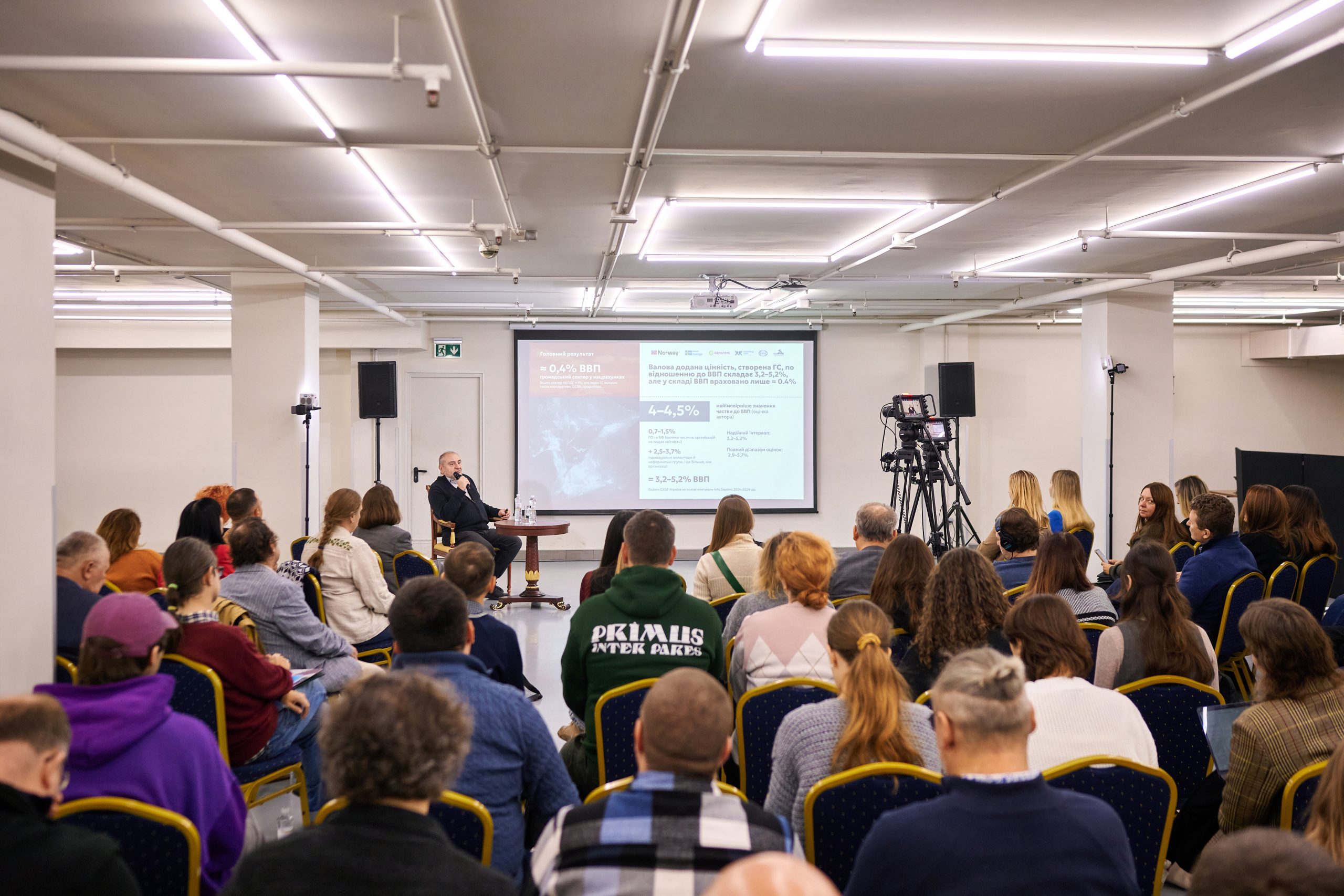
The findings were presented on 11 November in Kyiv. The study, authored by CASE Ukraine economist Volodymyr Dubrovskyi, provides the first comprehensive assessment of what has hitherto remained virtually invisible in official statistics: the value of voluntary work, the contribution of civil society organisations and charitable foundations, and employment in the sector.
“Only around 0.4 per cent of the civil society sector’s contribution to GDP is reflected in the system of national accounts. But we understand that civil society plays a much greater role in the economy. Civil society and charitable organisations create jobs, attract resources to Ukraine, mobilise volunteers and help tackle challenges that are important for the country. At ISAR Ednannia, we have long wanted to measure this contribution and make it visible not only to the public but also to those who make government and economic decisions. That is why we initiated the first study of its kind, which showed that the contribution of the civil sector amounts to 4–4.5 per cent of GDP,” notes Volodymyr Sheyhus, Executive Director of ISAR Ednannia.
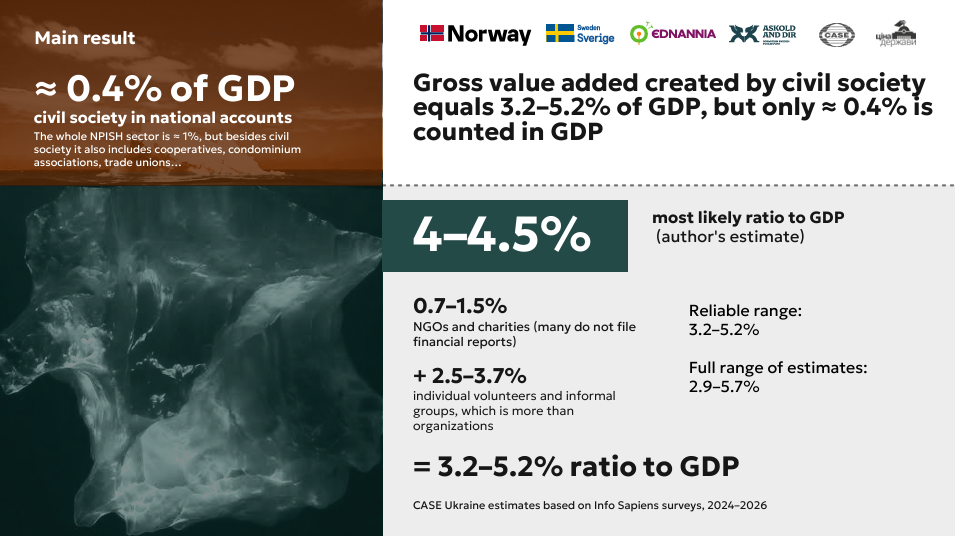
According to the study’s estimates, the public sector’s total contribution ranges from 3.2 per cent to 5.2 per cent of GDP, with the most likely estimate being 4–4.5 per cent. The largest share of added value is generated by individual volunteers working independently or in informal groups: their contribution is estimated at 2.5–3.7 per cent of GDP. A further 0.7–1.5 per cent of GDP is generated by civil society organisations and charitable foundations.
The scale of voluntary activity is confirmed by the results of public surveys: in 2025, 43.6 per cent of Ukrainians were involved in volunteering in one form or another. Around 5 million people raised funds, whilst 10.3 million provided assistance directly. Some Ukrainians combined both types of activity.
“According to our estimates, the contribution of the civil society sector to social welfare can be roughly compared to that of sectors such as construction, the extractive industries, education and healthcare. At the same time, the vast majority of this contribution is not recorded and does not feature in official statistics,” emphasised Volodymyr Dubrovskyi, the author of the study and an economist at CASE Ukraine.
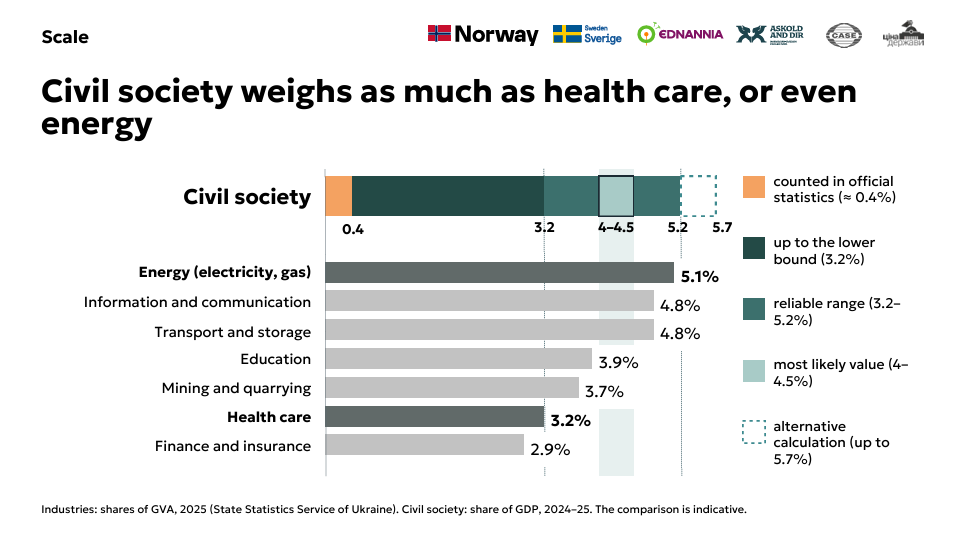
To assess the economic contribution of the public sector, the researchers used an approach based on a satellite account. This allows for an assessment of a particular sector’s contribution to the economy, specifically that part which is not reflected in official statistics.
The calculations were based on the labour cost method: value added included the wages of permanent staff (including taxes), services provided by sole traders, and volunteer hours, valued at the average hourly wage in Ukraine. Data from three Info Sapiens surveys conducted between 2024 and 2026 were used for this purpose.
The study was carried out by CASE Ukraine on behalf of ISAR Ednannia as part of the ‘Askold and Dir’ Fund, which is financed by Norway and Sweden.