
Eliminating the age-based excise tax on the import of used cars will not only lower their cost but also generate an additional 1 billion hryvnia for Ukraine’s budget each year.
Furthermore, imported used cars are expected to replace old Soviet and post-Soviet passenger vehicles, which will reduce harmful emissions and have a positive impact on the environment. A sociological survey on Ukrainians’ support for legislative initiatives that would make used cars more affordable shows that citizens see many benefits in this—from the ability to travel to the opportunity to look for work remotely. Over the 22 years of artificial restrictions on car imports, Ukrainians have lost $40 billion in welfare, and even after the partial liberalization of imports, they continue to lose $1.2–1.5 billion annually.
These and other findings were presented in a comprehensive study by the Center for Social and Economic Research (CASE Ukraine), conducted as part of a project by the Atlas Network (U.S.) in partnership with the Automotive Market Research Institute, titled “Affordable Cars vs. ‘Domestic Manufacturers’: What Has Automotive Protectionism Brought Ukrainians?” The aim of the study is to provide a balanced examination of the issue of protectionism in the national automotive industry, as well as to compare its negative and positive impacts.
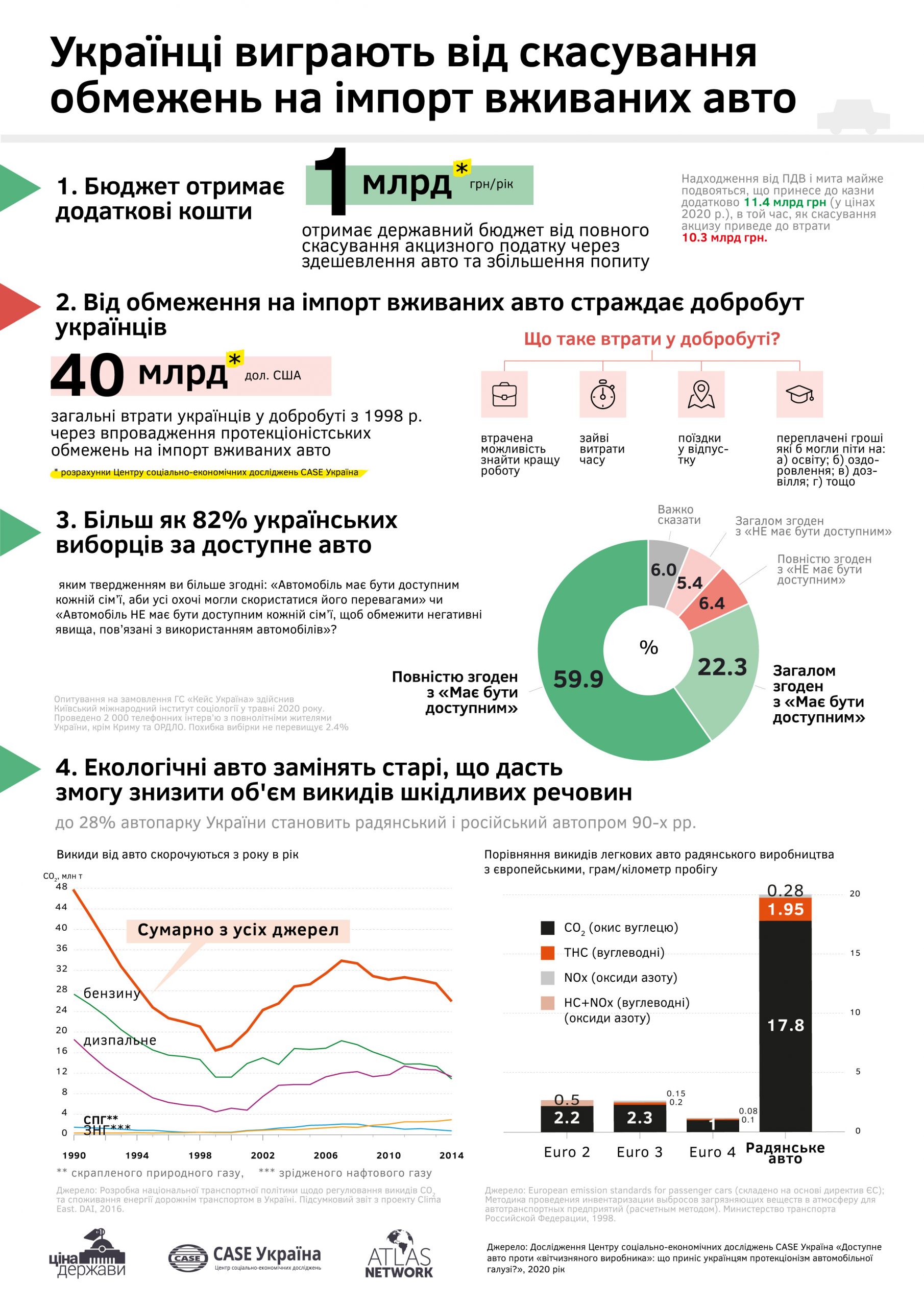
In particular, the Ministry of Finance of Ukraine opposes the abolition of the excise tax based on the age of imported vehicles, citing the lack of compensatory measures to offset the loss of revenue. According to the study’s co-author, CASE Ukraine Senior Economist Volodymyr Dubrovsky, calculations show that eliminating the “age-based” excise tax would double car imports to 700,000. “Revenues from VAT and customs duties would nearly double. This will bring an additional 11.4 billion UAH to the budget, while the abolition of the excise tax will result in a loss of 10.3 billion UAH,” adds Mr. Dubrovsky. Thus, by reducing the cost of customs clearance for used cars, the budget will not only avoid losses but will also receive an additional 1 billion UAH.
The so-called “age-based” excise tax currently in place—under which the older the imported car, the more one has to pay—is inherently discriminatory and illogical, since any product should lose value over the years of use, not the other way around.
“Today, for example, to import a 10-year-old diesel car with a 1.6-liter engine, you have to pay 1,200 euros in excise tax alone. And if that same car is already 15 years old, it’s 1,800 euros. And then there’s the import duty and VAT… Thus, clearing a car through customs can cost as much as 300% of its value,” notes the study’s co-author, Stanislav Buchatsky, head of the Automotive Market Research Institute. “In other words, citizens are paying for the private interests of automakers out of their own pockets.”
The study states that lobbyists have maintained restrictions on car imports for decades. “Such customs duties are a prime example of protectionism, which is not permitted in the EU. This is enshrined in law and reflected in judicial practice: taxes on cars cannot increase based on the car’s age, and EU member states cannot restrict car imports from other EU member states to favor sales on the domestic market. Ukraine has signed an Association Agreement with the EU, so lawmakers have no choice but to eliminate the age-based excise tax and adopt European rules for car imports,” emphasized Stanislav Buchatsky.
The authors of the study concluded that since the introduction of full-scale protectionism in 1998 to the present day, Ukrainian citizens have lost $40 billion in personal wealth. “We’re talking about lost opportunities to find better jobs, wasted time, and money overpaid for cars—money that could have gone toward education, healthcare, other goods, and leisure,” emphasized Volodymyr Dubrovsky.
The authors of the study also analyzed one of the public concerns regarding the increase in imports of used cars due to their lower prices—the threat to the environment. The argument is that emissions from used cars arriving from Europe will impact the environment. “First, compared to Europe, we have a very small vehicle fleet. There are 232 cars per 1,000 citizens, while in Europe this figure stands at 600 cars. Second, more than 28% of our vehicle fleet consists of old Soviet and post-Soviet carburetor-powered cars, which are the main culprits behind nearly all vehicle emissions. Importing used cars will, first and foremost, replace the Soviet legacy on wheels. And third, Ukraine’s passenger car fleet accounts for only 6.5% of all emissions in our country. The main source of air pollution is the energy sector, which produces 55.2% of emissions.
Specifically for this study, the Kyiv International Institute of Sociology conducted a survey in May 2020, which showed that more than 82% of citizens support affordable cars. “Support for the idea of making cars affordable for the public is entirely logical and understandable. For some, a car is an opportunity to work remotely—and 76.2% of respondents chose this option—while for others, it is an opportunity to travel and visit friends and family, with 72.2% selecting this answer. Additionally, 72.3% of those surveyed cited avoiding the use of public transportation as one of the benefits of making cars more affordable, which has become particularly relevant in light of the COVID-19 pandemic,” said Yevhen Shulga, Director of Development at CASE Ukraine and head of the sociological study.
In conclusion, the authors of the study highlighted three main findings:
First, protectionism does not promote the development of the industry; specifically, it has failed to create a competitive automotive industry. The main reason is that market protection was not implemented for a promising nascent industry that could compete in international markets, but rather for an industry with little potential.
Second, the current excise tax on imported used cars contradicts the European Union’s taxation principles, with which Ukraine has signed an Association Agreement. It is also unfair given that the cheaper the product (car), the higher the excise tax.
Third, fears regarding the negative consequences of increased car imports are exaggerated. One of the main concerns is the impact on the environment. However, it is important to understand that imported cars meeting standards such as “Euro-2” will, on the contrary, improve the environmental situation, as they will replace Soviet and post-Soviet carburetor-equipped cars, which are 5 to 8 times more harmful.