
Tackling ‘business fragmentation’, introducing higher rates for certain services and reviewing the second group could make the system fairer. However, mandatory VAT could drive small businesses into the informal economy.
The Ministry of Finance is preparing a reform of the simplified taxation system. Among the possible changes are measures to counter artificial ‘splitting’ of businesses, a review of the types of activity for the second group, differentiated rates for the third group, and mandatory registration as VAT payers once turnover reaches €85,000, or around 4 million hryvnias.
Oleg Getman, an associate expert at CASE Ukraine and coordinator of the Economic Expert Platform, notes in an article for CENSOR.NET that most of the proposed changes are justified, but warns against the premature introduction of VAT for sole traders.
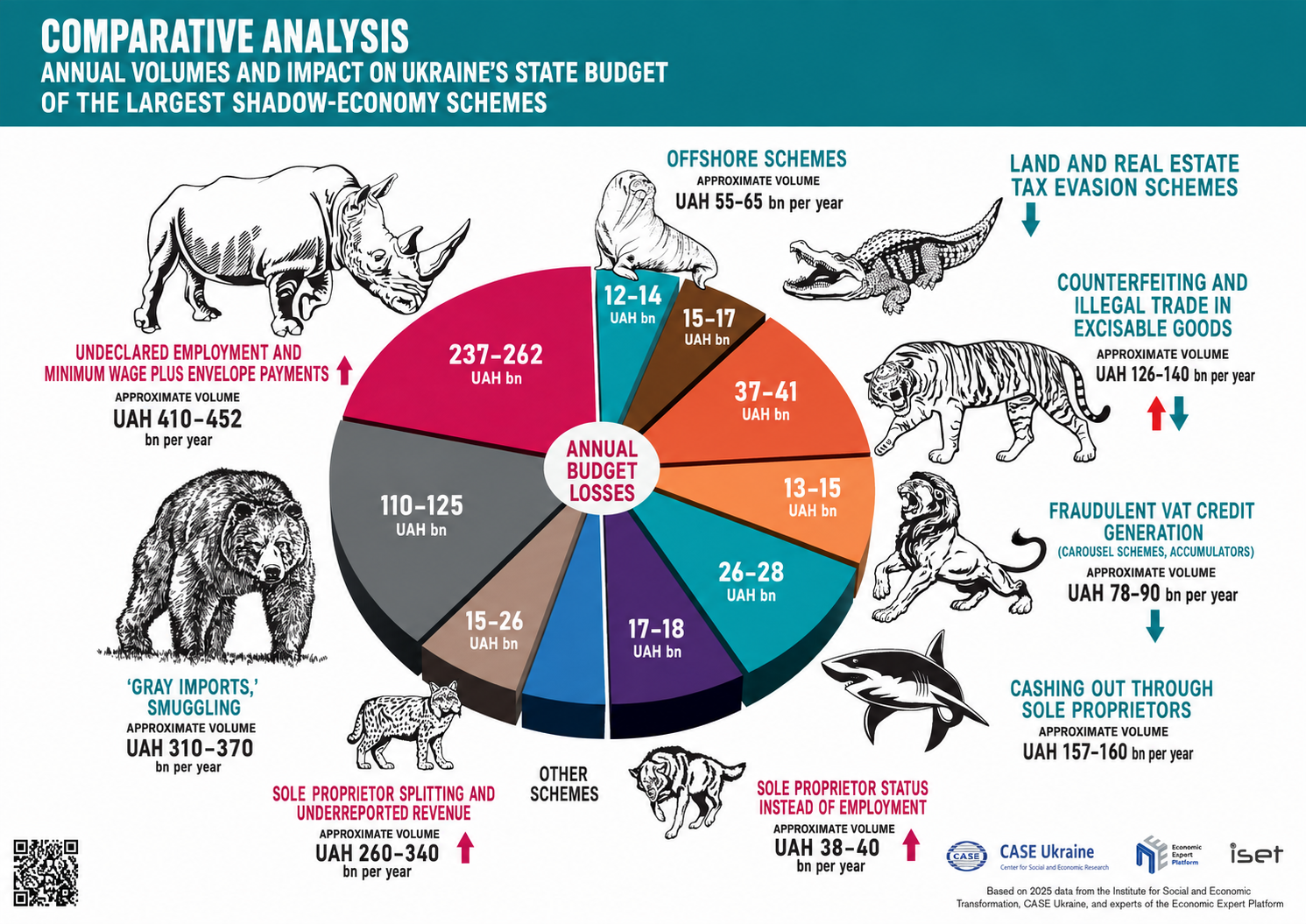
The most glaring problem with the simplified system remains its use by large businesses, which split their turnover amongst dozens or hundreds of formally independent sole traders. Budget losses from such schemes are estimated at 15–26 billion hryvnias per year. At the same time, this is significantly less than the losses from ‘off-the-books’ wages – 237–262 billion hryvnias – or ‘grey imports’ – 110–125 billion hryvnias.
To combat ‘fragmentation’, it is proposed that, rather than assessing individual formal criteria, their combination should be evaluated: shared management, staff, premises, accounting, branding and financial flows. This will make it possible to distinguish pseudo-sole traders from legitimate franchising, outsourcing and the operation of marketplaces.
For certain highly profitable professional services in the third group – consultancy, legal, accountancy, marketing and IT – the Ministry of Finance is considering a rate of up to 10 per cent. The author proposes limiting the rate to 8 per cent for a transitional period. Furthermore, it would be advisable to reclassify certain activities – notably wholesale trade, car sales and the restaurant sector – from the second to the third group.
The riskiest idea is mandatory VAT once the €85,000 threshold is exceeded. Administering the general system could take up to 595 man-hours and cost a business owner an additional 80,000–120,000 UAH per year. Without prior simplification of the VAT system, such a rule would only encourage further ‘fragmentation’ and the growth of the shadow economy. It should therefore be postponed until Ukraine joins the EU.
The main aim of the reform should not be to increase the number of taxpayers at any cost, but to tackle the shadow economy in a targeted manner whilst maintaining a simple system for genuine micro-businesses. At the same time, Ukraine needs to overhaul its tax, customs and financial monitoring systems, complete judicial reform and reduce the burden on the wage bill.