
The largest tax evasion and avoidance schemes will cost the Ukrainian budget hundreds of billions of hryvnias in 2025. According to estimates from new research by CASE Ukraine, the Institute for Socio-Economic Transformation (ISET) and the Economic Expert Platform (EEP), the largest fiscal gap in 2025 was caused by ‘envelope’ wages, breaches of customs regulations and ‘grey’ imports, as well as counterfeit goods and the illegal trade in excise goods.
If the estimates for all categories analysed in the study are added together, the potential losses amount to around 535–615 billion hryvnias per year. According to last year’s calculations, this figure stood at 429–543 billion UAH. However, this does not mean that the budget is actually missing out on exactly this amount: some of the schemes overlap, and losses from certain mechanisms are already partially accounted for in others. Therefore, the actual total amount is lower.
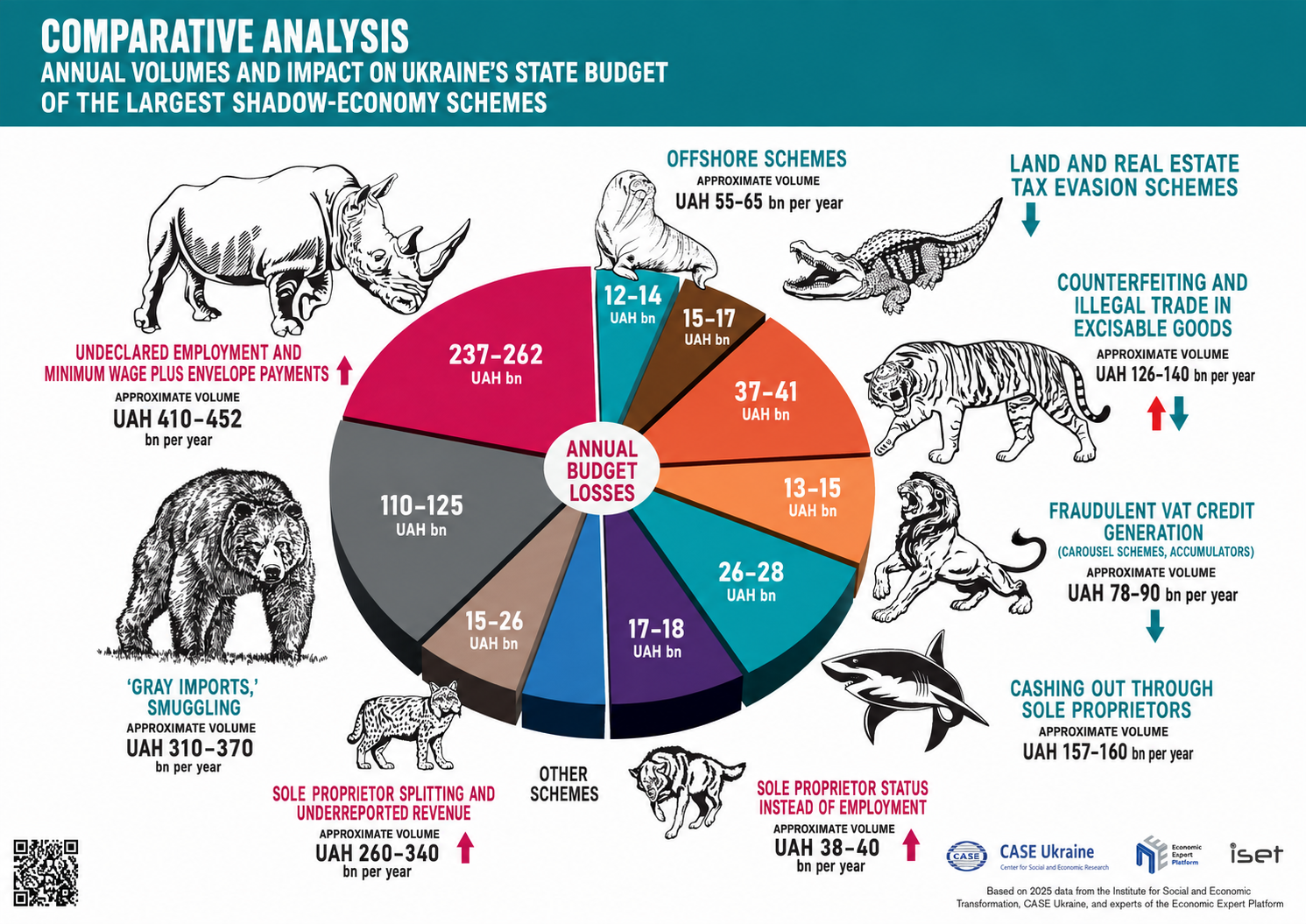
The biggest schemes in 2025:
- ‘Off-the-books’ wages and informal employment — 237–262 billion UAH in budget losses per year. This is the largest channel of the shadow economy. A year earlier, losses were estimated at 200–265 billion UAH.
- Breaches of customs regulations, smuggling, ‘grey’ imports and corruption at the border — 110–125 billion UAH. Last year, losses totalled 105–120 billion UAH.
- Counterfeit goods and the illegal trade in excise goods — 37–41 billion UAH. This primarily concerns tobacco, fuel and alcohol.
- Fictitious businesses, ‘drop’ schemes, code substitution, ‘carousel’ schemes and other schemes — approximately 38–48 billion hryvnias, although a significant proportion of these losses overlaps with other categories.
- ‘Tax evasion schemes’ and the creation of risky VAT tax credits — around 14–16 billion UAH per year.
- Offshore schemes and the transfer of profits abroad — around 12–14 billion UAH.
- Schemes relating to land and property taxation — around 18–20 billion UAH.
The study’s summary table also estimates losses arising from ‘using sole traders instead of hiring staff’ at 17–18 billion UAH, business fragmentation and under-reporting of revenue through sole traders at 10–19 billion UAH, and specific schemes for converting funds into cash via third-group sole traders at 26–28 billion UAH.
The three largest categories alone — ‘envelope’ wages, ‘grey’ imports and counterfeit goods — account for estimated losses of 384–428 billion hryvnias per year.
The study debunks the widespread claim that the simplified taxation system is the main cause of tax losses in Ukraine. Although there are instances of abuse of the simplified system, in fiscal terms these are significantly less significant than ‘off-the-books’ wages, smuggling and large-scale organised schemes. The authors emphasise that increasing administrative pressure on micro-businesses is not, in itself, capable of delivering a breakthrough for Ukraine in the fight against the shadow economy.
Large-scale schemes are gradually on the wane, but the problem has not gone away
One of the positive findings of the study is that schemes which, just a few years ago, were among the largest in scale are gradually shrinking. The volume of offshore profit transfers is at a historically low level, and the scale of VAT ‘schemes’ is significantly smaller than the peak figures of 2019–2020.
The authors of the study believe that a genuine breakthrough is possible through a comprehensive overhaul of the State Tax Service and the State Customs Service, the completion of the reform of the Economic Security Bureau, the elimination of ‘conversion centres’, improvements in the quality of tax and customs administration, and the continuation of judicial reform. The recommendations also include selecting the management and staff of key fiscal bodies through transparent competitive selection processes, strengthening analytical work, and evaluating the effectiveness of the services based on the reduction of the actual tax gap, rather than merely on the fulfilment of revenue targets.
The authors also cite the preservation of an independent anti-corruption infrastructure and the consistency of institutional reforms already underway as key factors for further de-shadowing of the economy.
The research, ‘A Comparative Analysis of the Fiscal Impact of Tax Evasion and Tax Avoidance Tactics in Ukraine’, was carried out by experts from CASE Ukraine, ISET and EEP, with the support of the Centre for International Private Enterprise (CIPE) and NED.